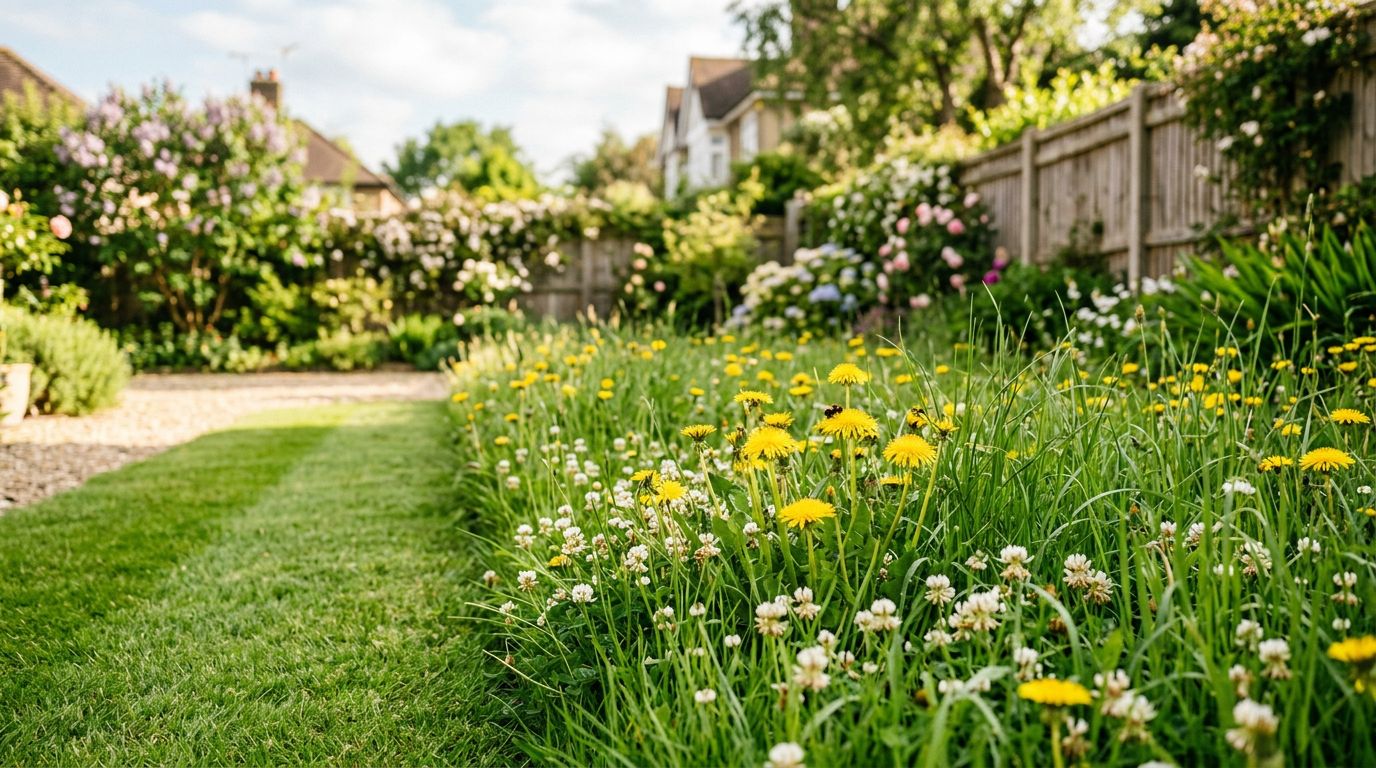
No Mow May: Should you stop mowing your lawn in May?
Imagine this: It is the first Saturday in May. The sun is shining, the grass is growing rapidly, and your lawnmower remains completely silent in the shed. You are doing nothing, and by doing nothing, you are saving the environment.
It is a compelling promise.

Over the past few years, "No Mow May" has transformed from a niche conservation suggestion into a global lifestyle movement. Hundreds of municipalities have suspended weed ordinances. Millions of homeowners have proudly let their turf grow wild, believing they are providing a crucial lifeline for hungry spring bees.
But as the grass gets taller, a quiet debate has been raging among entomologists, botanists, and turfgrass scientists.
Is a month of neglect actually helping native pollinators, or is it creating an ecological trap?
The British Roots of a Global Phenomenon
To understand the controversy, you have to look at where the movement started. No Mow May was launched in 2018 by Plantlife, a UK-based conservation organization responding to a staggering ecological crisis.
For the UK, targeting residential gardens made perfect scientific sense. Many British lawns are essentially "relic grasslands." Beneath the manicured green surface lie the seeds and rootstocks of native wildflowers, waiting for a chance to bloom. May historically aligns with traditional hay meadow management, where grass is left to grow long in the spring.
When British gardeners stopped mowing, native flowers actually appeared. The campaign was a massive success.
Then, the idea crossed the Atlantic.
The Flawed Science That Fueled a North American Craze
In 2020, Appleton, Wisconsin, became the North American epicenter for No Mow May. The city suspended its weed ordinances, hundreds of households participated, and a highly publicized study from Lawrence University was published in the journal PeerJ, claiming to prove massive benefits for local pollinators.
Cities across the United States and Canada immediately used this study to justify their own No Mow May campaigns.
There was just one massive problem.
🛑 The Retracted Study
In late 2022, the foundational Appleton study was officially retracted. Bee scientists discovered fundamental methodological flaws that slipped past peer review. The researchers had identified bee species by visual observation alone (which is often impossible without a microscope) and claimed to find bee species in Wisconsin during May that do not even exist in the state. Despite the retraction, many municipalities never updated their public messaging.
This revelation forced ecologists to look closer at what actually happens when a standard North American lawn goes unmown.
The Dandelion Deception
Unlike the relic meadows of the UK, most North American lawns are engineered turfgrass monocultures. They are planted with specific cultivars chosen for uniformity and vigor.
When you stop mowing a turfgrass monoculture for a month, you do not magically get a diverse native meadow. You get very tall grass.
Grass pollen is notoriously low in nutritional value, and many bee species actively avoid it. The flowers that do manage to pop up are usually non-native species introduced by European colonists—most notably, the dandelion.
While a lawn full of yellow dandelions looks like a pollinator paradise, nutritional science tells a different story.


Furthermore, dandelions possess allelopathic properties. Their pollen and roots can actually suppress the seed production of competing plants, making it harder for true native wildflowers to establish themselves.
As Grace Glynn, state botanist for the Vermont Fish & Wildlife Department, notes, the campaign has become "quite controversial." A lawn that was an ecological desert in April remains an ecological desert in May—the grass is just taller.
What the Research Actually Supports
If No Mow May is flawed, should you just go back to mowing every weekend? Absolutely not.
Rigorous, peer-reviewed science confirms that reducing mowing frequency provides undeniable, measurable benefits for arthropod diversity. The secret lies in the interval, not in total abandonment.
A 2023 study published in Conservation Evidence tested different mowing intervals on urban lawns during the peak growing season. The results were striking:
- Every 2 weeks: The standard baseline.
- Every 6 weeks: Resulted in 171% more pollinator visits.
- Every 12 weeks: Resulted in 179% more pollinator visits and doubled floral species richness.
Interestingly, the researchers discovered that the physical disturbance of mowing—the noise, vibration, and destruction—harms pollinators independently of flower removal. Less frequent mowing simply creates a safer habitat.
However, an earlier comprehensive study in suburban Massachusetts found a fascinating nuance. Across 16 residential lawns, researchers documented up to 111 different bee species. They found that lawns mowed every three weeks produced 2.5 times more flowers. Yet, lawns mowed every two weeks supported the highest absolute abundance of bees.
Why the paradox?
Because when grass gets too tall, small native bees physically cannot navigate the dense jungle of turf to reach the flowers.

A two-to-three-week interval represents the perfect middle ground: flowers have time to bloom, but the grass remains short enough for bees to access them.
The Climate Change Complication
There is one more variable disrupting the No Mow May narrative: the shifting calendar.
Recent phenological research shows that plants in the UK are now flowering a full month earlier on average than they did between 1753 and 1986. Driven by rising global temperatures, the ecological window is moving.
By the time May arrives, the critical early-season foraging window for newly emerged native pollinators may have already passed. Locking conservation efforts to a catchy calendar month ignores the reality of a rapidly warming planet.
The Verdict: Enter "Slow Mow Summer"
The scientific consensus is shifting away from a single month of extreme neglect toward a more sustainable, season-long approach.
Conservationists are increasingly advocating for "Slow Mow Summer." This approach abandons the rigid rules of May and instead focuses on a consistent, moderate reduction in mowing frequency from spring through autumn.
No Mow May succeeded brilliantly at one thing: it forced millions of people to question the ecological cost of the perfect American lawn. It proved that homeowners are willing to change their habits to help wildlife.
Now, the science is simply asking us to mow smarter, not just stop altogether.
Sources & Further Reading:
- Plantlife UK (2018). Origins of No Mow May and UK meadow loss data.
- PeerJ (2020, Retracted 2022). Lawrence University Appleton study on lawn mowing and pollinators.
- Conservation Evidence (2023). Study on urban lawn mowing frequency and pollinator abundance.
- Massachusetts Suburban Lawn Study. Research on bee abundance and 2-week vs. 3-week mowing intervals.
- Meta-analysis of 46 datasets on arthropod abundance and mowing frequency.
- Heather Holm, Bee Nutrition Expert. Data on dandelion vs. native plant protein content.
- Grace Glynn, Vermont Fish & Wildlife Department. Perspectives on North American lawn ecology.
- UK Phenology Study. Data comparing flowering dates (1753-1986 vs. 1987-2019).